

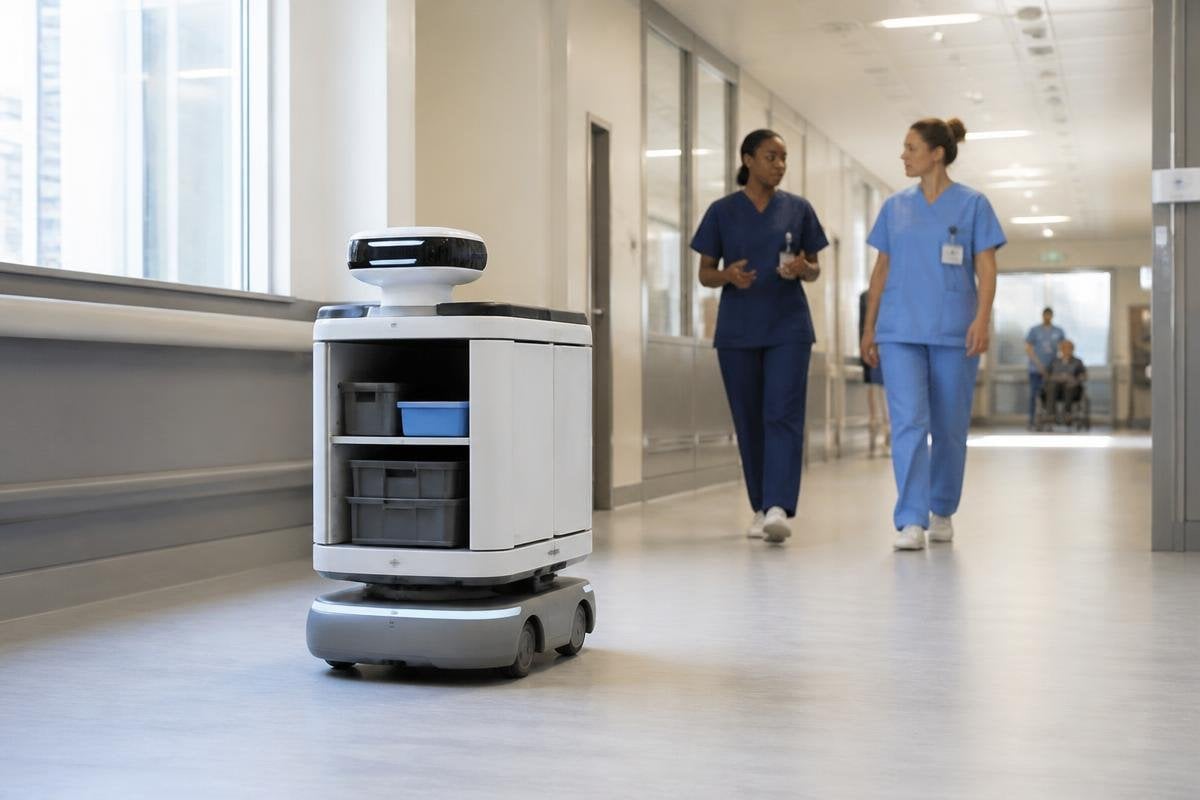
A robot can move supplies, lift a patient, or watch for a fall. It can’t replace the judgment, trust, and human contact that keep care safe. Without deployment data, the sound answer is limited: robots may ease parts of the shortage, but they won’t solve it alone.
Quick read
- Robots fit repeatable tasks with clear safety rules
- Staff still need to supervise, repair, and explain the system
- Hospitals should measure time saved, errors, and patient response
Where robots can help
The best starting point is work that takes staff away from patients. Mobile robots can carry medicines, linens, or samples through a building. That leaves nurses and support staff with more time for checks, treatment, and conversation.
Lifting is another possible use. Powered transfer devices can help move a patient from a bed to a chair. The machine takes some load from a worker’s arms, but staff still need to place the device, check the patient, and react if the transfer goes wrong.
Robots can also carry out narrow monitoring jobs. Camera systems may flag a person who has left a bed, while a small machine can remind someone to take a scheduled medicine. These systems raise an alert. A person still decides what the alert means and what to do next.
That division matters. Robots handle a defined action. A healthcare worker handles the changing situation around it.
Where the shortage remains
Healthcare work contains many tasks that change from one patient to the next. Pain, confusion, fear, language, and sudden illness can alter a plan within minutes.
Robots can follow their rules, but they may fail when the room stops matching those rules.
The staff burden can also move rather than vanish. Someone must charge the robot, clean it, update its software, check its sensors, and respond when it stops in a corridor.
Those duties may belong to nurses, technicians, or a new support team. Each option has a cost.
Training adds another demand. Staff need to know what the robot can do, where it can fail, and how to stop it. Patients and families need a clear explanation of the machine’s role. A system that saves walking time but creates confusion may leave the ward with a different problem.
The proof hospitals need
A vendor’s task video can’t answer the questions that matter on a working ward. Hospital leaders need results from the place where the robot will run, with the staff and patients who will use it.
That means measuring the full task, not one movement. If a robot carries a tray in two minutes but needs five minutes of staff setup, the five-minute total matters. The same check applies to faults, cleaning, charging, and human review.
For a hospital manager comparing a robot with another hire, Robot 24 can point to the named machine, task, trial site, and date behind a healthcare claim. Those details show whether the robot cuts staff work or adds setup, checks, and repairs to the shift.
A useful review should ask who ran the system, what job it handled, how long it ran, and what staff still had to do. Without those details, a promise remains a proposal.
A buying check for hospital teams
Use these questions before approving a pilot:
- Name the task: Can you describe the job in one sentence with a clear start and finish?
- Count staff time: Have you measured setup, supervision, cleaning, charging, and recovery from faults?
- Set the stop rule: Can a worker halt the robot at once from a reachable control?
- Check the handoff: Who responds when the system raises an alert or stops moving?
- Track patient response: Will you record complaints, refusals, injuries, and missed care?
- Price the support: Does the budget include training, service visits, spare parts, and software fees?
If the answers are weak, the hospital may be buying a machine before it has defined the problem.
What happens next
Robots can take on transport, lifting, monitoring, and other narrow jobs. The worker shortage needs more than that: enough people, good training, safe workloads, and systems that keep staff in the loop.
I’d fund robots when they remove a measured task from a care worker’s shift, then keep the pilot only if patient safety and staff time improve together. The deciding number is the total staff time saved per shift after setup and support, not the number of tasks shown in a demo.
